




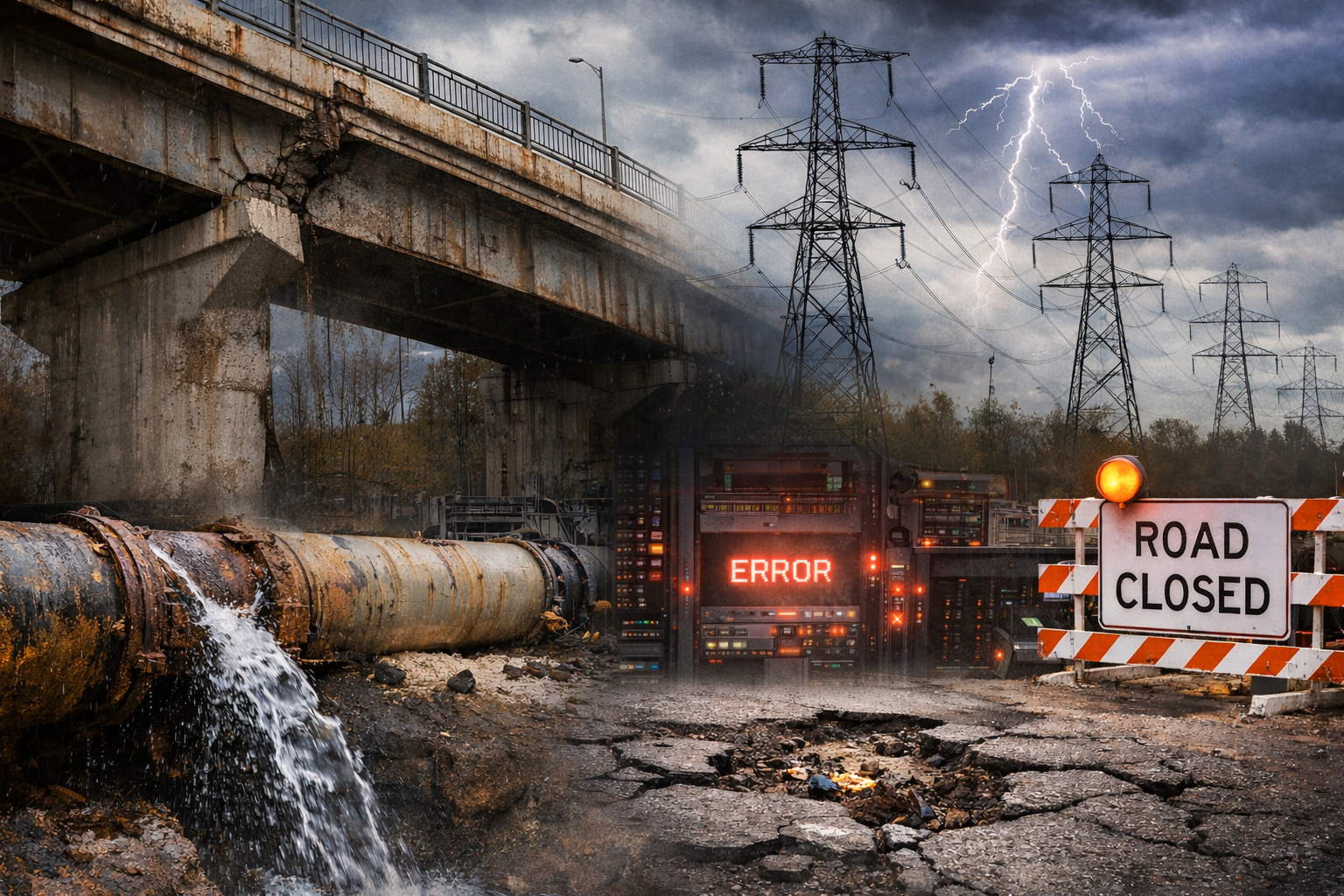
Infrastructure failures rarely come out of nowhere.
A bridge shuts down with little warning.
A water system becomes unsafe overnight.
A power outage cascades across an entire region.
Public explanations often frame these events as unexpected. In reality, most failures follow a familiar pattern. The warning signs appear early. The stress builds slowly. Action comes late.
Understanding why infrastructure fails the same way over and over is the first step toward reducing how often it happens.

Infrastructure Is Designed to Wear Down
Most critical infrastructure systems are not built to last forever.
Road surfaces degrade.
Pipes corrode.
Electrical equipment loses capacity.
Control systems fall behind modern demand.
This decline is expected. Engineers plan for it. Maintenance schedules exist specifically to manage gradual wear.
The problem is not that infrastructure ages.
The problem is that maintenance is often delayed until decline turns into visible failure.
When repairs wait that long, costs rise and options narrow.
The Warning Signs Are Usually Documented
Before most infrastructure breakdowns, there is a paper trail.
- Inspection reports showing early damage
- Deferred maintenance lists that grow each year
- Budget requests that go unfunded
- Temporary fixes that quietly become permanent
These signals are rarely hidden. They appear in capital plans, internal audits, and public records.
What stops action is not lack of awareness. It is the tension between long-term risk and short-term priorities.
Infrastructure competes poorly with more immediate political and budget pressures.
Small Problems Cascade Into System Failures
Modern infrastructure does not operate in isolation.
A power disruption affects water treatment.
A software outage slows emergency response.
A bridge closure overloads nearby roads.
As systems age, they lose resilience. Minor failures that once stayed contained begin triggering wider disruptions.
To the public, these moments feel sudden. In reality, the system has often been operating near its limits for years.
Why Maintenance Is Hard to Defend
New construction is visible. Maintenance is not.
Expansions create ribbon cuttings and public wins. Preventive repairs preserve existing systems quietly, without obvious payoff.
This dynamic creates a familiar cycle:
- Maintenance is delayed
- Risk accumulates
- Failure forces emergency spending
- Repairs cost more and solve less
Emergency fixes are rarely efficient. They respond to damage rather than preventing it.
How Technology Both Helps and Hurts
Digital tools now sit on top of physical infrastructure.
Sensors, automation, and remote monitoring can improve efficiency and detect problems earlier. At the same time, outdated software introduces new vulnerabilities.
When digital systems fail alongside physical ones, recovery becomes slower and more complex. Modern infrastructure gains capability, but also fragility.
Where Infrastructure Investment Is Starting to Work
Despite the challenges, not all infrastructure stories end in failure.
Some agencies and regions are changing how systems are managed. Progress is uneven, but measurable improvements are emerging.
4
Approaches showing results include:
- Condition-based maintenance that uses data to identify problems before failure
- Long-term capital planning that extends beyond election cycles
- Incremental upgrades instead of large, one-time rebuilds
- Clear ownership, where one agency is accountable for outcomes
These strategies do not eliminate risk, but they reduce surprise and control costs.
Why Fixes Move Slower Than Failures
Even proven improvements face real limits.
- Funding often arrives in short bursts rather than sustained cycles
- Skilled labor shortages delay upgrades
- Legacy systems restrict how quickly new tools can be deployed
This makes progress feel invisible. Systems improve quietly, while failures demand immediate attention.
What Signals Real Improvement
Announcements are not the best indicator of progress. Results are.
Readers should watch for:
- Fewer emergency repairs
- Smaller outage footprints
- Predictable maintenance schedules
- Transparent reporting on system condition
When agencies track and publish these metrics consistently, risk drops. When they don’t, failures tend to repeat.
What This Means Going Forward
Infrastructure failures are not isolated events. They are system signals.
They reveal where risk has been allowed to accumulate and where long-term planning has been deferred.
The question is not whether infrastructure will fail again.
It is whether the warning signs will be acted on early enough to change the outcome.